04.12.2025
The unwritten rules
In Life Science, we are used to working within structures. Not because we love rules for the sake of rules, but because frameworks create clarity, safety, and confidence.
The Christmas party is the evening we loosen up and let laughter take up more space than the agenda. But it is still part of working life – which means rules and agreements still apply. It’s a work event, not a private party.
The dress code, however, lives in small social cues you suddenly need to interpret. Often, it’s not the small talk that makes you nervous – it’s the outfit. Standing in front of the mirror trying to decode what “festive attire” really means, switching outfits again and again. That’s exactly why the dress code is worth discussing.
Comfortable, confident and no worries
If you want to get it right, think “professionally festive.” Not professional in a stiff way – but in the sense of: I can be myself while respecting the setting and the people around me.
A simple rule of thumb: If you’d feel comfortable meeting both your manager and a new colleague in your outfit during the evening, you’re good.
Company Christmas parties have a magical ability to last for hours. An outfit that looks great for 20 minutes but feels like a compromise after four hours can dampen the whole experience. For many in Life Science who wear uniforms daily – lab coats, hairnets, safety shoes, cleanroom gear – the Christmas party is the moment to relax into your own style. Festive and comfortable is often the best combination.
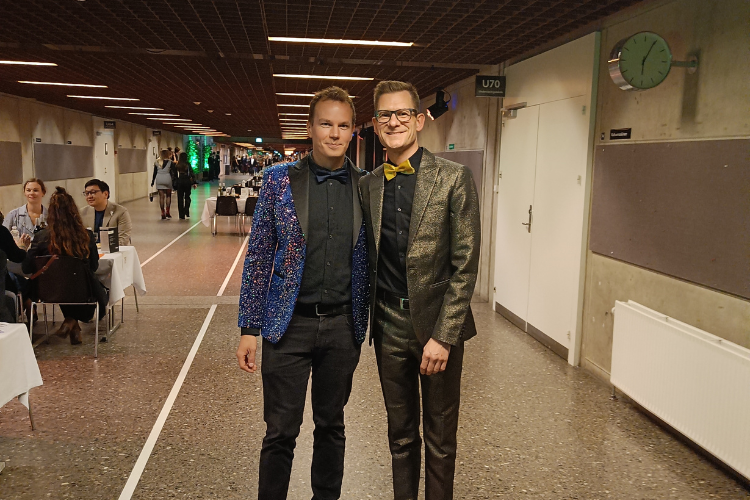
In the photo on the right, you see Peter Thøgersen, pharmacist and health policy consultant at Pharmadanmark. At our Christmas party last Friday, he hit the perfect balance for him: a gold bow tie, a glitter suit, and a fantastic presence. He felt comfortable – and that made it easy to enjoy the evening without worry.
It’s rarely the glitter that’s the problem
The real pitfalls are things like:
- Clothing with offensive or inappropriate messages – for example slogans or symbols that undermine others or create discomfort
- Very sexualised or revealing clothing that shifts attention from celebration to awkwardness
- Forced “theme dressing,” where you feel pressured to buy or wear something to fit in
And remember the classic Life Science principle: safety beats style.
Christmas parties can include slippery floors and stairs, so choose shoes you can wear all evening – not only through the starter. And if work tasks before or during the event require safety measures, the employer must provide the right protection and guidance.
If the dress code feels pointless (or just unclear) – ask HR or the organisers
The most professional way to handle dress-code uncertainty is to clarify it early. That’s not being difficult – it’s preventing misunderstandings, something our field is very good at.
Start with the invitation: There’s often more information than you think – “black tie,” “festive,” “smart casual,” “theme,” or clues in the venue or programme.
Check your employee handbook or policies if guidelines exist. If the wording feels outdated, vague (“nice clothing”) or unexplained, keep it simple: ask HR or management about the intention.
A dress code should be explainable in one or two sentences: What are we trying to achieve? What atmosphere do we want to create? If the answer is unclear, it’s a sign the communication needs refinement – and clarifying it helps everyone.
If you feel an expectation is gendered, unreasonable, or exclusionary, it’s also completely legitimate to reach out to your union representative or health and safety representative for guidance – preferably before you’re standing there with Christmas glitter in one hand and a sense of “must I really…?” in the other.